Ecuador: unfair competition will not be tolerated

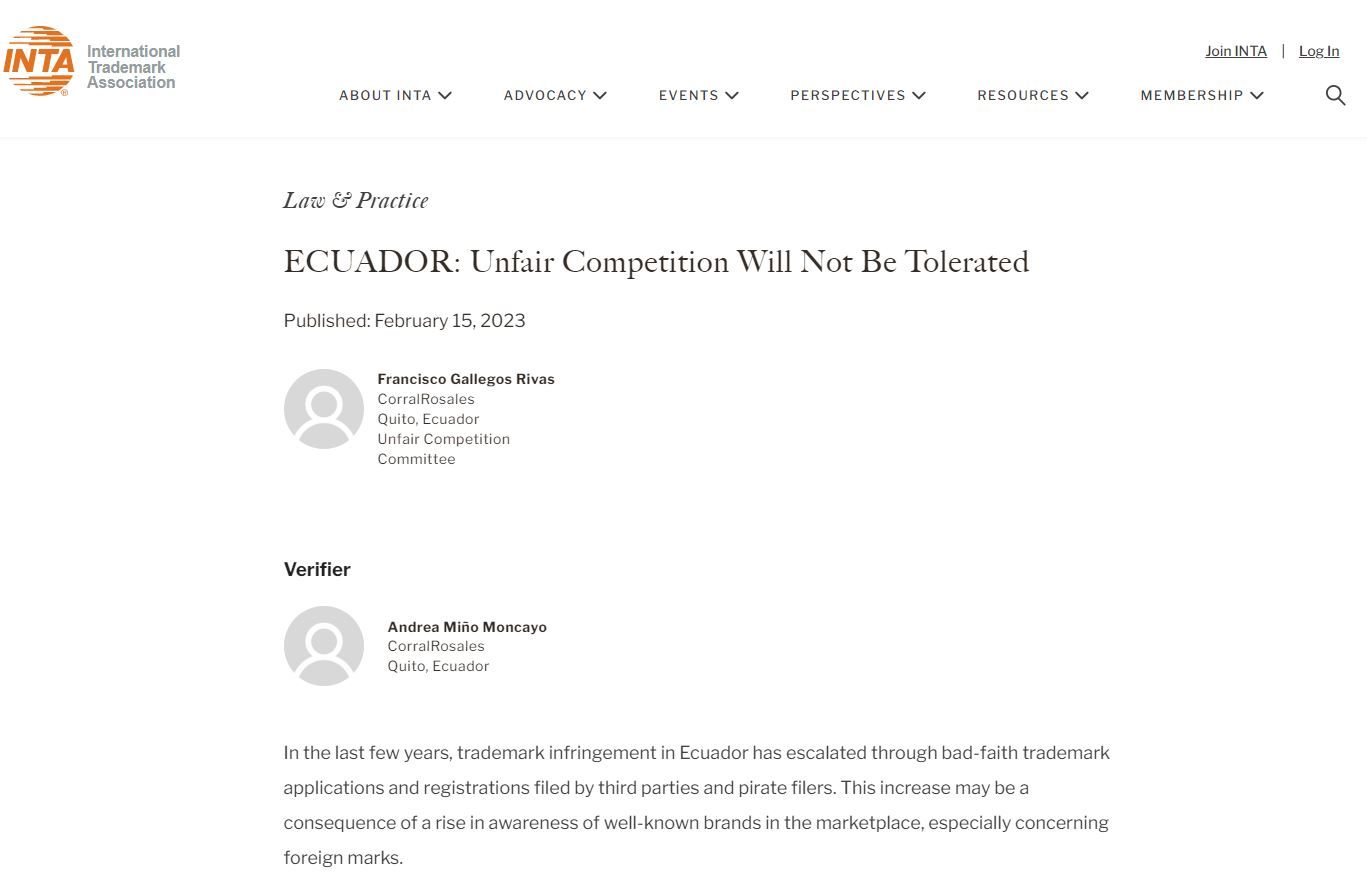
Recorte del artículo de Francisco Gallegos, de CorralRosales, publicado en International Trademark Association

DETAILS

DATE: 24-02-2023

PROFESSIONALS INVOLVED IN THE ARTICLE:

Francisco Gallegos

It is no secret that, in recent years, trademark infringement in Ecuador has intensified through bad faith trademark applications and registrations filed by third parties and counterfeiters. What is the reason for this increase? Our partner Francisco Gallegos explains in a new article written for the International Trademark Association (INTA) that it may be due to the fact that there is now a greater awareness of well-known trademarks in the market, especially with regard to foreign trademarks.

Francisco Gallegos explains in his article that in Ecuador unfair competition will no longer be tolerated and will be punished. To this end, he analyzes a specific case: on August 3rd of last year, “an appeal (file number OCDI-2019-055-AN), filed by Baldoré Cía. Ltda, the National Service of Intellectual Rights (SENADI), issued a groundbreaking pioneer decision by determining that the trademark DON CASTELÓ SPECIAL and the design granted in favor of Coello & Coello Coelcem Cía. Ltda. were null and void for having been obtained to perpetuate, facilitate, or consolidate an act of unfair competition, taking advantage of the prestige and position achieved by the legitimate owner”. It also adds that there were “reasonable grounds” to establish that this registration contravened the Common Regime on Intellectual Property of the Andean Community (Decision 486), as well as the principles of legal competition and good faith.

Baldoré Cía. Ltda. had not registered its trademark DON CASTELÓ in Ecuador; however, it did provide evidence of marketing authorizations and invoices that demonstrate the availability of DON CASTELÓ products in that market, as well as the sales made, and the market positioning achieved.

“Based on this evidence, SENADI concluded that the disputed registration constituted an act of unfair competition and that the improperly granted registration influenced the market by intentionally confusing the consuming public about the origin of the product, and harmed the true owner of the trademark,” Francisco explains.

It is important to keep in mind that, according to article 259 of Decision 486 of the Common Regime on Intellectual Property of the Andean Community, “any act that could create confusion among consumers in the market would be considered an act of unfair competition”. Therefore, since both parties are in direct competition, it would be a mistake to maintain the registration of the trademark since this would create confusion amongst consumers.

The author of the text concludes with the following perspective: “This decision is groundbreaking, as SENADI rarely deals with unfair competition issues and in limited cases has protected unregistered trademarks, as in this case (Ecuador has a first-filing jurisdiction). As one of the first decisions in Ecuador to address the issue and punish a bad-faith registration, SENADI sets an important precedent for trademark protection”.

If you want to read the full article, click here.

Operation of economic concentration in the pharmaceutical market is denied by the Superintendence for the Control of Market Power – LIR

Recorte de "The Legal Industry Reviews", el artículo escrito por Christian Razza

DETAILS

DATE: 23-02-2023

PROFESSIONALS INVOLVED IN THE ARTICLE:

Christian Razza

On August 9, 2022, the acquisition of Leterago del Ecuador S.A. (hereinafter, Leterago) was denied to Distribuidora Farmacéutica Ecuatoriana DIFARE S.A. (hereinafter, Difare) by the Superintendencia de Control del Poder de Mercado (SCPM). Our associate, Christian Razza, writes about it for The Legal Industry Reviews (LIR).

To understand the current situation, one must also know the context: Difare is an Ecuadorian company dedicated to the distribution and commercialization of pharmaceutical products that manages the Pharmacys pharmacy chains and the Cruz Azul and Comunitarias franchise systems. Leterago, on the other hand, is a national company that primarily markets and distributes all types of pharmaceutical products.

Razza, in order to explain why the operation was denied, states that “the economic concentration operation was denied by the authority when considering that it generates multiple risks for the competitive scheme of the following relevant markets: distribution of pharmaceutical products at national level and commercialization of pharmaceutical products at local level”.

The Superintendence for the Control of Market Power carried out an investigation in which it was determined that there were high levels of concentration resulting from the operation. This produced a joint share of more than 60% within the pharmaceutical distribution market, “due to the fact that the transaction involves the concentration of the two main distributors of pharmaceutical products in Ecuador, eliminating the independence of Difare’s main competitor”, he adds.

After the study, the authority determined that “there are no behavioral or structural measures that would mitigate the reduction of the competition schemes of the defined markets, without sacrificing the current efficiency levels of the sector, as well as the welfare of the clients of the operators involved”. It also adds that “the measures proposed by Difare did not solve the risks identified by the SCPM, since they would not have modified the structure of the market, nor the behavior of the participants to generate or make viable a dynamic competitive environment”.

This operation is not the first to be denied by the SCPM. It is the fourth economic concentration operation denied throughout its history, the three previous ones being: the merger between Holcim Ltd. and Lafarge S.A. (2014), the acquisition of Swissgas del Ecuador S.A. by Indura Ecuador S.A. (2014) and the acquisition of International Laboratories Services Interlab S.A. by Synlab Sociedad Anónima.

Razza, to conclude the article, also focuses on detailing how the first three cases were denied:

“The first case was denied since the merger between Lafarge and Holcim would result in a concentration in the Ecuadorian cement market with more than 95% share by the merged entity, thus there would be a serious risk of anticompetitive practices.

The second case was rejected on the basis of a highly concentrated market and regulators’ concerns about the potential for collusion.

The third case was denied since the parties opted not to proceed with the transaction, for which the withdrawal of the notification was requested, but the SCPM considered that Synlab failed to comply with the condition of subscribing a document of commitments within the 90-day term determined in the resolution of January 7, 2021 and therefore denied the authorization of the economic concentration operation”.

If you want to read the full article, click here.

Caterpillar successfully opposes the registration of FUNKY CAT based on its CAT marks – WTR

Recorte del artículo sobre "Caterpillar se opone con éxito al registro de FUNKY CAT basado en su marca CAT" en WTR

DETAILS

DATE: 18-01-2023

CORRALROSALES IN THE NEWS:

-Katherine González

The National Service of Intellectual Rights (SENADI) has declared, after resolving three oppositions against applications for trademark FUNKY CAT in classes 9, 35 and 37, that said trademark is not registrable. The reason: there is a risk of confusion or association with the CAT trademark. In this case, our associate Katherine González H. writes for World Trademark Review (WTR).

On December 22, 2021, Great Wall Motor Company Limited filed applications for registration of mark FUNKY CAT. Caterpillar Inc. filed oppositions based on its trademark CAT in several classes and also claimed that its trademark CAT is well-known.

On June 7, 2022, Great Wall Motor answered the oppositions and claimed that the applied-for marks were distinctive enough, insisting on the oppositions to be rejected and the applications granted.

FUNKY CAT registration resolution

Our associate explains that, through Resolutions No. 2000627, 2000632 and 2000631, SENADI accepted the oppositions and rejected the registration of trademark FUNKY CAT in Classes 9, 35 and 37.

SENADI argued that consumers could be confused between the goods and services offered by each company, as there are similarities between the conflicting marks, and “could be led to believe that they are provided by the same company.” SENADI concluded that there is a high risk of confusion or association and accepted the oppositions. It also considered that the inclusion of the term “Funky” was not sufficient to avoid the likelihood of confusion among consumers.

González concludes her analysis with an interesting comment: “Besides recognizing the opposing’s party’s rights, avoiding registration of similar trademarks, these cases are interesting, since usually the Ecuadorian IP Office tends to dismiss oppositions just based on the coexistence of the conflicting word in the relevant classes. However, in these cases the IP Office did not focus on this aspect and considered the overall similarities between the conflicting marks as a whole, as ordered by the Court of Justice of the Andean Community.”

If you want to read the full article (under subscription), click here.

74.1% of the investment in Ecuador comes from national capital – El Comercio

Recorte de El Comercio de un artículo en el que se menciona a Andrea Moya, socia de CorralRosales

DETAILS

DATE: 11-10-2022

CORRALROSALES IN THE NEWS:

-Andrea Moya

MEDIA:

El Comercio

In the first quarter of 2022, Ecuador approved 27 investment contracts. Of these, 74.1% corresponds to national investment and 25.9% to mixed investment (national and foreign). According to the Ministry of Production, Trade, Foreign Trade, Investment and Fisheries, the total amount reached USD 420 million, which represents an 86% increase in local investment in relation to the same period of 2021.

The media El Comercio attended a breakfast organized by CorralRosales and Softlanding in which our partner Andrea Moya and the Undersecretary of Investment of the Ministry of Production, Marco Moya gave a talk on the subject.

As Marco Moya explains, “with the signing of investment contracts, a company commits to make new investments and the State provides legal certainty. This applies to any sector of the economy. The main objective is to increase production in Ecuador and generate employment”.

It is important to know that these contracts grant tax incentives to new investments, such as a five-point reduction in the income tax rate, exemption from foreign exchange tax (ISD) and foreign trade taxes on the import of raw materials and capital goods necessary for the execution of the investment.

Our partner, as an expert in investment contracts, explains that “these benefits and incentives apply for the duration of the contract and must not exceed the amount of the investment”. “The agriculture, livestock, forestry and fishing, manufacturing, and transportation and storage sectors account for 91% of the investment contracts approved in the first quarter of 2022,” she adds.

If you want to read the full article, click here.

SENADI refuses to register mark in Class 41 on the ground that it would affect Netflix´s rights – WTR

Recorte del artículo "El SENADI deniega el registro de la marca en la clase 41 por afectar a los derechos de Netflix", escrito por Katherine González, asociada de CorralRosales, para el medio WTR

DETAILS

DATE: 12-09-2022

PROFESSIONALS IN THE NEWS:

-Katherine González

MEDIA:

WTR

“In the opposition proceeding against the application for the trademark CHOLOFLIX in class 41, the National Service of Intellectual Rights of Ecuador (SENADI) has considered that the trademark was not registrable because there is a risk of confusion or association on the part of consumers. This is due to the existence of the trademark NETFLIX of Netflix Inc in class 41″. This is how the article written by our associate Katherine González H. for WTR opens -wherein she covers the reasons behind the decision.

The process began on May 21, 2020, when a natural person applied for registration of the trademark CHOLOFLIX for services in class 41, specifically: “education; training; entertainment; sporting and cultural activities; supply of films, not downloadable, by means of video on demand services; supply of television programs, not downloadable, by means of video on demand services; distribution of films; entertainment services.

Netflix, in the face of this, filed an opposition based on the trademark NETFLIX, which covers the following aspects of class 41:

“Entertainment services; information on entertainment activities; production of films other than for advertising; provision of films and television programs that are not downloadable via video on demand streaming services”, among other.

In addition, the entertainment company NETFLIX claimed that it was already known to a lot of population. In the counterclaim, the plaintiff replied on February 8, 2021, claiming that NETFLIX was a weak mark and therefore did not have distinctive character. It requested, therefore, that the opposition be dismissed and the application be granted.

On July 18, 2022, SENADI issued Resolution No. 2000254, whereby it accepted the opposition and rejected the registration of the trademark CHOLOFLIX. It also pointed out that it would be difficult for consumers to easily differentiate the services offered with similar names and that they could consider that the conflicting services were provided by the same company; therefore, there was a risk of confusion or association.

Our associate has added the following comment in conclusion: “although SENADI accepted NETFLIX’s opposition and rejected a detailed analysis of the similarities between the trademarks, as well as the identity of the services in question, there was no analysis – nor mention – of the well-known character of the NETFLIX trademark alleged by NETFLIX. Although SENADI has improved its analysis in trademark oppositions compared to previous years, the motivation is still insufficient as it does not make an exhaustive assessment of all the arguments raised by the parties. This assessment is especially important in opposition proceedings, where third party rights are at stake.”

If you want to read the full article (under registration), click here.

LexLatin – HIG Capital Becomes a Majority Shareholder in Ransa, from Grupo Romero

LexLatin - HIG Capital Becomes a Majority Shareholder in Ransa, from Grupo Romero - CorralRosales - Lawyers Ecuador

DETAILS

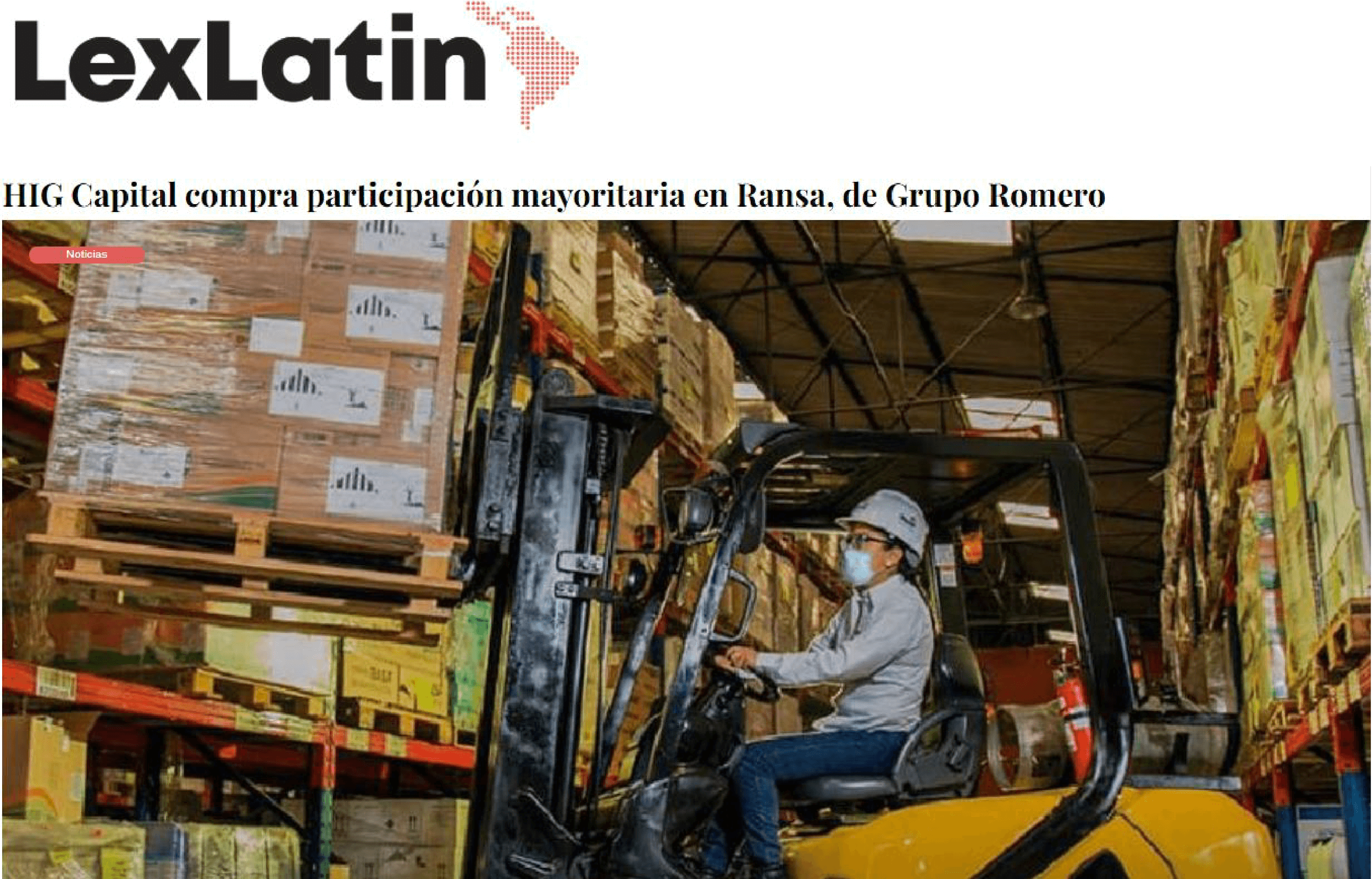
CorralRosales represented HIG Capital, an American alternative investment company, to become a majority shareholder in Ransa, a company dedicated to logistics services with a large presence in the Andean region and Central America.

The following CarralRosales’s Lawyers took part in the purchase and sale process during “Operation 1”: Partners Xavier Rosales and Andrea Moya, along with associates Milton Carrera, Ana Samudio, Rafael Serrano, Ramón Paz and Miño, Marta Villagómez, María Isabel Torres, Darío Escobar, Sofía Rosales and Edgar Bustamante.

According to the LexLatin medium, “the terms of the negotiation, signed on September 21 and closed on October 29, were not disclosed.” Grupo Romero, owner of Ransa, “will remain a strategic partner of the company.”

“The acquired companies are: Inversiones Logicorp, Ransa Comercial, Agencias Ransa and Almacenera del Perú (Perú); Ransa Operador Logístico Bolivia (Ransabol – Bolivia) and Logistics Operators of Central America (OLCA – Panama)”, according to Ingrid Rojas, a LexLatin journalist.

If you want to read the complete news, click here.

The benefits of the ICSID Convention vis-à-vis foreign investors

The benefits of the ICSID Convention vis-à-vis foreign investors - CorralRosales - Sofía Rosales - Lawyers Ecuador

During this past month, Ecuador’s ratification of the ICSID Convention and its direct influence on the attraction of foreign investment has been the subject of many comments.

Why is it key to attracting foreign investment? Dispute resolution under the ICSID Convention has many advantages, and particularly regarding arbitration, there are 3 main characteristics that make it so attractive to investors: (i) it is an institution specialized in international investments; (ii) it provides for the automatic recognition of awards; and (iii) it has its own procedure for annulment of awards. Below an analysis of these characteristics:

  1. Specialized institution in international investments:

Having an arbitration administered by ICSID gives the investor the security of having a global and independent institution specifically dedicated to the settlement of international investment disputes. It is often difficult for a foreign investor to invest in a country if, in the event a dispute arises, it would be resolved by the country’s own courts. This generates a disadvantage for the investor and a feeling of lack of protection, especially considering that local courts often do not have the necessary experience in this field.

In an arbitration administered by ICSID, an impartial arbitral tribunal, which is expert in the subject matter, and has an in-depth knowledge of international investment disputes- which are often the cause of disputes- is constituted.

  • Automatic recognition of awards:

The Contracting States – currently numbering 156 (including Ecuador) – are compelled to automatically recognize the award rendered under the ICSID Convention, as if it were a decision issued by the courts of that country, i.e., without the need to carry out the formal recognition procedure known as exequatur. This facilitates, simplifies, and significantly shortens the time in which the award is enforced, which means less time and costs for both the investor and the State.

  • Procedure for annulment of awards:

As a general rule in international arbitration, an action for annulment of an award is brought before the ordinary courts of the country of the seat of arbitration. On the contrary, in the case of an arbitration administered by ICSID, such action is brought before the Center itself, in such a way that that no local courts of any State are involved, but an ad hoc commission composed of 3 individuals selected from the list of arbitrators of the Center (other than the members of the tribunal that rendered the award, and of different nationalities from any of the members of such tribunal and the parties) is appointed.

In conclusion, the protection derived from the arbitration procedure under the ICSID Convention enhances the foreign investor’s environment, which, undoubtedly, added to other measures adopted by the government, could turn Ecuador into a sort of investment hub in Latin America.

Sofía Rosales
Asocciate at CorralRosales
srosales@corralrosales.com

Latin Lawyer – IBM´s US$60 billion global spinoff calls on Latin American firms

Latin Lawyer - IBM´s US$60 billion global spinoff calls on Latin American firms - CorralRosales - Lawyers Ecuador

DETAILS

DATE: 18-10-2021

CORRALROSALES IN THE NEWS:

Andrea Moya

Edmundo Ramos

Xavier Rosales

Darío Escobar

Edgar Bustamante

Marta Villagómez

Milton Carrera

Ramón Paz y Miño

Sofía Rosales

MEDIA: Latin Lawyer

Multinational technology company IBM has hired CorralRosales, along with other Latin American firms, to carve-out Kyndryl. It does so by establishing the managed infrastructure services unit as an independent business.

This carve-out, in which our team of experts has been working on and which has a global value of US$60 billion, was signed on September 1. The aim is for Kyndryl to become an independent company headquartered in New York by the end of 2022. 

On behalf of CorralRosales, the advisors in the transaction are partners Xavier Rosales, Edmundo Ramos, Andrea Moya; and associates Milton Carrera, Marta Villagómez, Sofía Rosales and Darío Escobar in Quito; and associates Ramón Paz y Miño and Edgar Bustamante in Guayaquil.

According to Latin Lawyer, “IBM’s Shareholders will receive at least 80.1% of Kyndryl’s common stock once the spinoff is complete, with IBM retaining the remaining stake. (…) While IBM and Kyndryl will be independent entities, at launch they will both be each other’s biggest clients and remain as strategic partners”.

If you want to read more (under registration), click here

The extraordinary appeal for review provided for in the Organic Administrative Code, against the decisions issued by the National Service of Intellectual Rights

The extraordinary appeal for review provided for in the Organic Administrative Code, against the decisions issued by the National Service of Intellectual Rights - CorralRosales - Lawyers Ecuador

The Organic Administrative Code (“COA”) provides that, against the decisions issued by the public administration, there are two kinds of appeals: ordinary appeal and extraordinary appeal for review. The first seeks to have the authority re-analyze the merits of the case with a view on modifying its decision. The extraordinary appeal for review, on the other hand, is possible only when any of the specific grounds provided for in the COA are met – it does not constitute a third instance – hence its extraordinary nature. In recent years, a common practice has been to file an extraordinary appeal for review against final decisions denying or granting the registration of a trademark, against which the ordinary appeal has already been lodged -or it was not filed in due course- in order for the National Service for Intellectual Rights (“SENADI”) to change its criteria regarding the risk of confusion or association between the conflicting marks. Although the SENADI prima facie gives way to this type of procedure, it has stated that “The extraordinary appeal for review constitutes a legal remedy aimed at correcting an error in the formation of the administrative will, or any illegality in the issuance of the decision, with the interested party having the ordinary remedies to disagree with the criteria of the judge, in this case, with the comparative analysis of the confronted marks.[1]

In this regard, Article 232 of the COA provides that “The interested individual may file an extraordinary appeal for review of the final administrative act when any of the following circumstances are verified:

1. That when issuing them, an obvious and manifest factual error has been incurred in, which affects the merits of the case, provided that the factual error results from the documents incorporated into the file.

2. That when issuing them, an obvious and manifest error of law has been incurred in, which affects the merits of the case. (…) The extraordinary appeal for review shall be filed, in the case of cause 1, within a period of one year following the date of notification of the contested decision (…)”.

It derives from the aforementioned provision that, unlike the ordinary appeal, the extraordinary appeal for review is not intended to review the legal arguments relied on by the authority in its decision but is aimed at reviewing and remedying, if necessary, defects in the processing of the administrative proceeding.

Unfortunately, nowadays, many users have chosen to file extraordinary appeals for review when what they are really requesting is to review the existence or not of the risk of confusion between two trademarks. And this is usually done as a way of demonstrating dissatisfaction with the decision issued through second instance decisions. An example of this can be found in case No. SENADI-2016-92900, in which SENADI admitted to process an extraordinary appeal for review against a decision denying an appeal in which the opposition filed was accepted, and the registration of a trademark was rejected. Within the aforementioned extraordinary appeal for review, the arguments used to request the revocation of the decision were:

  • Comparison between the confronted trademarks and the supposed absence of risk of confusion.
  • Absence of spelling and phonetic similarities between the conflicting marks.
  • Lack of competitive connection between the protected goods.

It is evident that the grounds for the aforementioned extraordinary appeal for review are not related to those provided for in Article 232 of the COA and what the applicant is seeking is to review again a decision that has already exhausted all administrative instances.

We will have to wait for the final decision of SENADI to have a clearer vision of its criteria in this matter. However, it is to be expected that the authority will reiterate the aforementioned criterion, rejecting the extraordinary appeal for review at the time of issuing the final decision (although it should have done it at the admissibility stage), thus putting an end to this practice. If so, with this precedent, SENADI should not admit to process these kinds of appeals in the future, since it is extremely important that the extraordinary nature of the appeal for review is respected in order to safeguard legal certainty and avoid its use as a kind of third instance by the interested parties.

[1] Decision OCDI-2021-230 from March 30, 2021. Proceeding 15-1516-RV-2S-RR-2018.

Katherine González H.
Asocciate at CorralRosales
katherine@corralrosales.com

LexLatin – Acquisitions in Ecuador: the most important operations so far this year

LexLatin - Acquisitions in Ecuador: the most important operations so far this year - CorralRosales - Lawyers Ecuador

DETAILS

DATE: 29-09-2021

CORRALROSALES IN THE NEWS:

Xavier Rosales

Andrea Moya

MEDIA: LexLatin

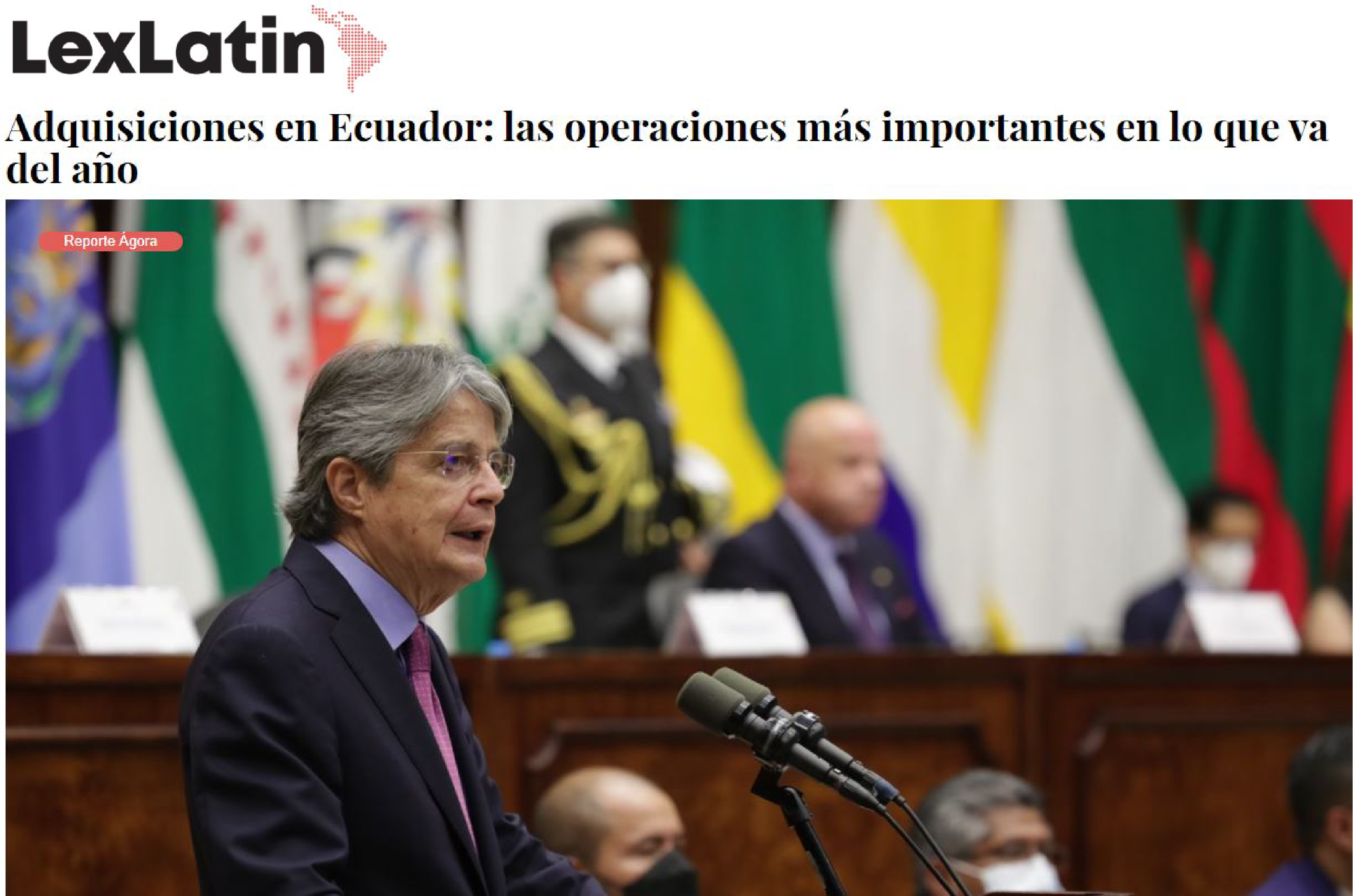
Ágora, a tool that systematizes and orders data on acquisitions, outputs, and financing in Latin America, published the number of operations completed during January and August of this same year: 14, which translates into 3,836 million dollars, an amount that is 3,348 million dollars more than the accumulated during the same months of 2020.

Our partner, Xavier Rosales, participated in the most important operation in the first two quarters in Ecuador: the purchase of the Lumen business in Latin America by Stonepeak Partners. Countries such as the United States, Australia, Venezuela, Uruguay, Peru, Mexico, Costa Rica, Colombia, Argentina, Brazil, and Panama were also part of this operation.

“We have the pleasure of advising Lumen for several years,” said Rosales for the medium. He also emphasizes that CorralRosales “has participated in different operations related to change of ownership and business focus, adjusting to the needs of the business sector mainly served by Lumen”.

Without a doubt, working on this operation from Ecuador is a challenge since the transactions are subject to regulatory authorizations. Our partner points out that “the advantage is that the regulations applicable to these authorizations are clear, which allows adequate planning and predictability”, making it possible to obtain permits in the shortest possible time.

Andrea Moya, a partner at CorralRosales also participated in the transaction. She believes that “there are three key elements in the current Ecuadorian situation: the adverse effects generated by the pandemic on the liquidity of companies, which have forced many of them to seek foreign investors; the change of government, which meant a shift towards a favorable environment for investors, and last but not least, the success of the vaccination plan, which has allowed the reactivation of the economy”.

CorralRosales Operations

Our firm currently has 3 operations with $ 3,160,000,000 in total transactions.

Regarding the position in which CorralRosales finds itself, Moya explains that the number of clients has grown significantly. “We see it as a rebound from the pandemic and due to the need to adapt to a new reality. We also see it as an effect of the favorable environment that the new government has generated for business development”, he adds.

If you want to read more, click here