Single Income Tax on Sports Betting Operators

DETAILS

DATE: 23-06-2023

PROFESSIONALS INVOLVED IN THE ARTICLE:

Andrea Moya

MEDIA:

– LexLatin

In 2011 a referendum held in Ecuador in which, among others, the following question was asked: Do you agree that businesses dedicated to gambling, such as casinos and gambling halls, should be prohibited in the country? A majority of the population voted in favor of the consultation and, consequently gambling was banned.

Following the recent creation in Ecuador of the “Single Income Tax on Sports Betting Operators”, our Partner Andrea Moya publishes an article in LexLatin analyzing this issue.

On May 17, 2023, the President of the Republic issued a Decree-Law for the Strengthening of the Family Economy and, on June 16 the Constitutional Court issued a favorable opinion.

This Decree-Law creates the “Single Income Tax on Sports Betting Operators”. The taxable event, explains Andrea, “is receiving Ecuadorian source income derived from sports betting activities carried out live, through internet or any other means”.

Andrea states in the article that the tax rate is 15% of the taxable base, and will be calculated according to the following rules:

  1. Operators with tax residence in Ecuador: The taxable base will be equal to the total income (including commissions) minus the total prizes paid in the same period. Prizes will be deducted from the taxable base if 15% of the value of the prize has been withheld by the operator.
  2. Non-resident operators: The taxable base will be equal to the total amount paid by the user in each transaction, i.e., the total value of the bets. If the bet is made through an intermediary, the intermediary must collect the tax from the user and pay it to the Internal Revenue Service.

Additionally, our Partner indicates that “the beneficiaries of the prizes will pay a 15% tax on the value of each prize received, in cash or in kind. If the price is paid by an operator located in Ecuador, the operator must withhold the tax”.

Consequently, “those users who place bets through non-resident operators, will be subject to a higher tax than those who place bets through resident operators, since, in this case, they will only pay the tax on the value of the prizes; while, in the first case they will pay a tax on the value of the prizes and on the bets”.

In the present case it is important to take into consideration that users who place bets through non-resident operators are already subject to a higher tax burden, since the value of their bets is subject to the payment of: (i) outflow tax (ISD), if the user, within each fiscal year, exceeds the tax exempt value; and, (ii) Value Added Tax (VAT).

“The Single Income Tax on Sports Betting Operators will become effective as from January 1, 2024. Therefore, the Presidency must issue the necessary rules to regulate its collection until December 31, 2023. It is to be expected that these regulations will clear, among others, the doubts raised in the preceding paragraphs”, she concludes.

If you want to read the complete article, click here.

Registered rights versus use in the market in opposition proceedings

DETALLES

FECHA: 10-05-2023

PROFESIONALES EN LA NOTICIA:

Andrea Miño

MEDIO:

– WTR

“The concept that trademark registration grants ownership of and exclusive rights to use a trademark to identify and protect the goods and services for which it was registered is accepted worldwide”.

“When the IP Office grants a trademark registration, it confers rights and obligations to the owner, including the ability to oppose a third party’s application for an identical or confusingly similar trademark. As part of the opposition proceedings, the defendant may submit evidence to refute the opponent’s allegations”, as explained by our associate Andrea Miño in an article published in WTR.

Miño recalls that “in recent years, it has become common practice for an applicant whose mark is being opposed to submit evidence demonstrating that the use of the opponent’s mark is limited to specific goods or services, in an attempt to minimise the risk of confusion between the conflicting marks”.

In some of these cases, she adds, “the IP Office considered these allegations to be valid and allowed the registration of trademarks similar to previously registered trademarks – thus erroneously applying the specialty principle, which directly affects registration rights, one of the fundamentals of trademark law. Such ex officio restriction of the goods was a clear overreach of the examiner’s powers, in violation of the trademark owner’s rights”.

Our associate analyzes a recent case examined by the Intellectual Property Office in an opposition proceeding in which an applicant downloaded content from the opponent’s website in order for the Intellectual Property Office to consider only the products offered on that website (pharmaceutical products for the treatment of hypertension and heart failure), despite the fact that the trademark on which the opposition was based was granted for pharmaceutical, among other products.

The applicant sought to obtain the registration of a confusingly similar trademark to protect other types of pharmaceuticals (medicines for respiratory diseases).

Resolution No OCDI-2023-291 sets an important precedent whereby, in opposition proceedings, the registration rights must prevail over the use of the mark in the market. The decision makes it clear that, in order to obtain the limitation of a registration, there are other legally established proceedings, which can also be used as a defence in the opposition proceedings.

If you want to read the complete article, click here.

Occupational health promotion regulation

From the 14th of May 2023, companies must implement an Occupational Health Promotion Plan, accordingly to the following considerations:
Scope:
All public or private work centers with 25 or more employees are obligated to implement the Occupational Health Promotion Plan; hereby the “Plan”.Stages:Planification: this stage requires an occupational health, security and practices evaluation as well as identifying problems and necessities. It also requires establishing activities that motivate personnel into a healthy lifestyle and work condition.

Implementation: in this stage the company must design an educational program for employees and notify the National Health Authority about the Plan implementation in the workspace for its evaluation.

Work centers must appoint a health professional as “Focal Point” to lead and form the work team that will oversee the Plan implementation.

Approval on the “Actívate y Vive” certificate: the Health Authority will issue a compliance report of the Plan and as a result the “Actívate y Vive” certificate.

Renewal: companies must request a renewal of the certificate in the dependencies appointed by the Health Authority for this purpose.

The Quality Assurance in Health Services and Prepaid Medicine Agency (ACCES) or whoever acts in its place will verify the existence of the “Actívate y Vive” certificate from December of 2023.

The “Actívate y Vive” certificate will be valid for two years and obligated companies must request its renewal four months before the expiration date.


Edmundo-Ramos-abogados-ecuador

Specialist in Labor Law
Edmundo Ramos, partner at CorralRosales
eramos@corralrosales.com
+593 2 2544144

Would you like to receive our newsletters with information like the one you have just read?
Click here and subscribe.

NOTE: The above text has been prepared for informational purposes. CorralRosales is not liable for any loss or damage incurred as a result of acting or failing to act on the basis of the information contained in this document. Any additional determined situation requires the specific opinion and concept of the firm in Quito / Guayaquil, Ecuador.

CORRALROSALES

Decree Law for strengthening the family economy

On May 17, 2023, the President issued the draft of the Decree-Law for Strengthening the Family Economy. This Decree-Law will enter into force once the Constitutional Court issues a favorable opinion. A public hearing is scheduled for June 6, to analyze this matter. The following is a summary of the most relevant issues:

1. Individuals Income Tax

Increases the amount that individuals may apply as a rebate for personal expenses with respect to the income tax incurred, according to the following detail:

a. Individuals without family dependents: the amount of the rebate will be equal to 18% of the lower value resulting from the personal expenses declared in the respective fiscal year and the value of the basic family basket (US$764.71 for 2023) multiplied by 7.

b. Individuals with family dependents: the amount of the rebate will be equal to 18% of the lesser value resulting from the personal expenses declared in the respective fiscal year and the value of the basic family basket multiplied by the applicable number, according to the following table:

Family dependents are parents, spouse or common-law partner and children up to 21 years of age or disabled of any age; if they do not receive taxable income and are dependent on the taxpayer.

c. Individuals who have dependents with catastrophic, rare and/or orphan diseases: the amount of the rebate will be equal to 18% of the lower value resulting between the personal expenses declared in the respective fiscal year, and the value of the basic family basket multiplied by 20.

If the value of the rebate exceeds the amount of the tax incurred, there will be no refund of the excess.

The income tax table is replaced by the following, which reduces the tax burden for individuals:

The provisions related to the rebate for personal expenses and the table for calculating income tax for individuals will be applicable as from the current fiscal year 2023.

2. Sole Income Tax on Sports Betting Operators

The “Single Income Tax on Sports Betting Operators” is created. The taxable event is receiving Ecuadorian source income derived from sports betting activities carried out live, through internet or any other means.

The taxpayers are:

a. Individuals or entities with tax residence or permanent establishment in Ecuador that carry out sports betting activities.
b. As substitute taxpayers, users of sports betting platforms when the operator does not have tax residence or permanent establishment in Ecuador.

The tax rate is 15% of the taxable base. The taxable base will be calculated according to the following:

a. Operators with tax residence in Ecuador: The taxable base will be equal to the total income (including commissions) minus the total prizes paid in the same period. Prizes will be deducted from the taxable base if 15% of the value of the prize has been withheld.

b. Non-resident operators: The taxable base will be equal to the total amount paid by the user in each transaction, i.e., the total value of the bets. If the bet is made through an intermediary, the intermediary must collect the tax from the user and pay it to the Internal Revenue Service.

The beneficiaries of the prizes will pay a 15% tax on the value of each prize received, in cash or in kind.

The Single Income Tax for Sports Betting Operators will become effective as of January 1, 2024.

3. Simplified Regime for Entrepreneurs and Popular Businesses (RIMPE)

The following are excluded from the RIMPE Regime:

a. Those taxpayers engaged in the production, importation and/or first stage of commercialization of goods or rendering of services taxed with Special Consumption Tax (ICE).
b. Taxpayers who carry out economic activities excluded from the RIMPE regime, even when they simultaneously carry out non-excluded activities.
c. Taxpayers qualified as artisans.

Taxpayers subject to the RIMPE regime will pay the tax according to the following progressive tables:

If, at the end of the fiscal year, the taxpayer had gross income over USD$300,000.00, it must file and pay income tax under the general regime. Prior to this reform, the taxpayer had to apply the general regime in the following year.

The period for the liquidation and payment of income tax corresponding to the RIMPE regime is extended from March to June of each fiscal year.

With respect to Value Added Tax (VAT), the transfer of ownership of tangible property, rights and the rendering of services carried out by popular businesses will be taxed at a 0% VAT rate.

Payments made to taxpayers categorized as popular businesses will not be subject to income tax withholding. In the case of payments made to entrepreneurs, the Internal Revenue Service will determine the income tax withholding percentages.


Andrea Moya - CorralRosales - Lawyer Ecuador

Specialist in Tax Law
Andrea Moya, partner at CorralRosales
amoya@corralrosales.com
+593 2 2544144

Would you like to receive our newsletters with information like the one you have just read?
Click here and subscribe.

NOTE: The above text has been prepared for informational purposes. CorralRosales is not liable for any loss or damage incurred as a result of acting or failing to act on the basis of the information contained in this document. Any additional determined situation requires the specific opinion and concept of the firm in Quito / Guayaquil, Ecuador.

CORRALROSALES

Beginning of the sanctioning regime of the Organic Law on Personal Data Protection

On May 26, 2021, the Organic Law for the Protection of Personal Data (the “LOPDP“) entered into force with its publication in Official Gazette Supplement 459. However, the sanctioning regime began to apply as of May 26, 2023, as established in the First Transitory Provision: “(the…) provisions related to the corrective measures and the sanctioning regime will enter into force two years after the publication of this Law in the Official Gazette”.

In the course of this time, whoever oversees the processing of personal data had to adapt its activities to the precepts established in the LOPDP, whose purpose is to protect the fundamental rights and freedoms of data owners and their right to the protection of personal data.

The process of adapting to the new information processing depends on the type of company (public entity, multinational, SME, self-employed, among others) and, above all, on the types of data processed (health data, credit data, data of children or adolescents).

The main obligations of companies are summarized below:

1.    Scope of application of the LOPDP:

•    The law is applicable to any processing of personal data, whether in physical or digital format, including its automation and any additional use.

•    Both legal and natural persons, public or private, must comply with the obligations imposed by the LOPDP.

2.    Individuals involved in data protection:

•    The controller is the person, natural or legal, who decides on the purpose and treatment of the personal data collected.

•    The processor is the person who provides a service to the controller that involves the processing of personal data in the name and on behalf of the Controller.

•    The data subject is the natural person whose data is subject to processing, such as name, surname, ID card number, health data, religion, credit data, gender, ethnicity, fingerprint, among others.

3.    New obligations:

The LOPDP obliges to include new warnings, for example: the legal basis for data processing or data retention periods. In addition to the following:
•    Consent: this must be a free, specific, informed, and unequivocal manifestation. This implies that the data controller must be able to prove that it had the consent of the data subject.

•    Relationship between data controllers and data processors: describes the type of contract between the data controller and the data processor. It specifies the obligations of both parties for the provision of the agreed service.

•    Risk analysis: those who process data must carry out a risk analysis on the processing of data, before implementing its use, to minimize the impact, it may have on data subjects.

•    Rights: provides data subjects with a series of rights to ensure data protection, such as: access, rectification, erasure, opposition, portability, not be subject to a decision based solely or in part on automated assessments, among others.

•    Data Protection Officer (“DPO”): those who process personal data, depending on the volume, category, and treatment of data, must appoint a DPO who will be the one to carry out a permanent and systematized control of personal data.

4.    Data Protection Authority (“DPA”):

The LOPDP provides for the creation of the Superintendence of Personal Data Protection, which will oversee the correct application of the law.

5.    Corrective actions:

The DPA shall take corrective measures to prevent further infringement. These measures could be:

•    Cessation of processing.
•    Erase of the data.
•    Imposition of technical, legal, organizational, or administrative measures.

6.    Sanctioning measures:

Establishes an administrative regime whereby there are minor and major offenses. The fines are based on the volume of business:
•    Minor offenses: are sanctioned with fines that go from 0,1% to 0,7%.
•    Major offenses: are sanctioned with fines that go from 0,7% to 1%.

So far, the regulation to the LOPDP has not been issued, nor has the DPA been appointed. However, as the sanctioning regime is already in force, those who use personal data must implement data processing policies and data protection measures to avoid fines.

CorralRosales has formed a team specialized in data protection to provide legal advice and consulting. LOPDP compliance audits are performed, as well as documents related to personal data protection.

Rafael Serrano, asociado de CorralRosales, con traje y corbata. En el fondo, una parte de Guayaquil (Ecuador)

Specialist in Data Protection Law
Rafael Serrano, associate at CorralRosales
rserrano@corralrosales.com
+593 2 2544144

Would you like to receive our newsletters with information like the one you have just read?
Click here and subscribe.

NOTE: The above text has been prepared for informational purposes. CorralRosales is not liable for any loss or damage incurred as a result of acting or failing to act on the basis of the information contained in this document. Any additional determined situation requires the specific opinion and concept of the firm in Quito / Guayaquil, Ecuador.

CORRALROSALES

Ecuador’s PDPL: challenges of the entry into force of its sanctioning regime

DETAILS

DATE: 23-05-2023

PROFESSIONALS INVOLVED IN THE ARTICLE:

Rafael Serrano

MEDIA:

– IAPP

The entry into force of the EU General Data Protection Regulation in May 2018 prompted the creation and adaptation of different regulations on personal data protection worldwide. Ecuador was no exception, and on May 26 2021 the Organic Personal Data Protection Law (PDPL), the first law in Ecuador focused exclusively on regulating and guaranteeing personal data protection, entered into force.

Two years later, as stipulated by law, the corrective measures and the sanctioning regime have come into force. Our associate Rafael Serrano writes on this matter in IAPP.

Serrano points out that “as of May, and since the publication of the PDPL, and private entities have been obliged to undertake adaptation processes that have meant significant challenges for them, which have deepened due to the lack of regulation for the application of the PDPL, as well as the lack of creation and designation of a data protection authority”.

These difficulties, he says, “added to the technical, legal and procedural actions the regulated entities adopted, have undoubtedly generated great uncertainty regarding compliance with and application of the PDPL”.

As of May 26, according to Serrano, “a new stage in the protection of personal data in Ecuador will begin. The risks can be significant, as fines can reach up to 1% of the fiscal year’s turnover immediately before the fine’s imposition”.

He states that the law generates a new regulatory regime that positions Ecuador at an international level since, even with all the risks mentioned above, it also presents great opportunities.

“Compliance with this regulation will improve processes and information systems, and help Ecuadorian companies strengthen their corporate images in the international market. In this sense, companies must begin to mitigate risk by implementing certain documents and security measures”.

If you want to read the complete article, click here.

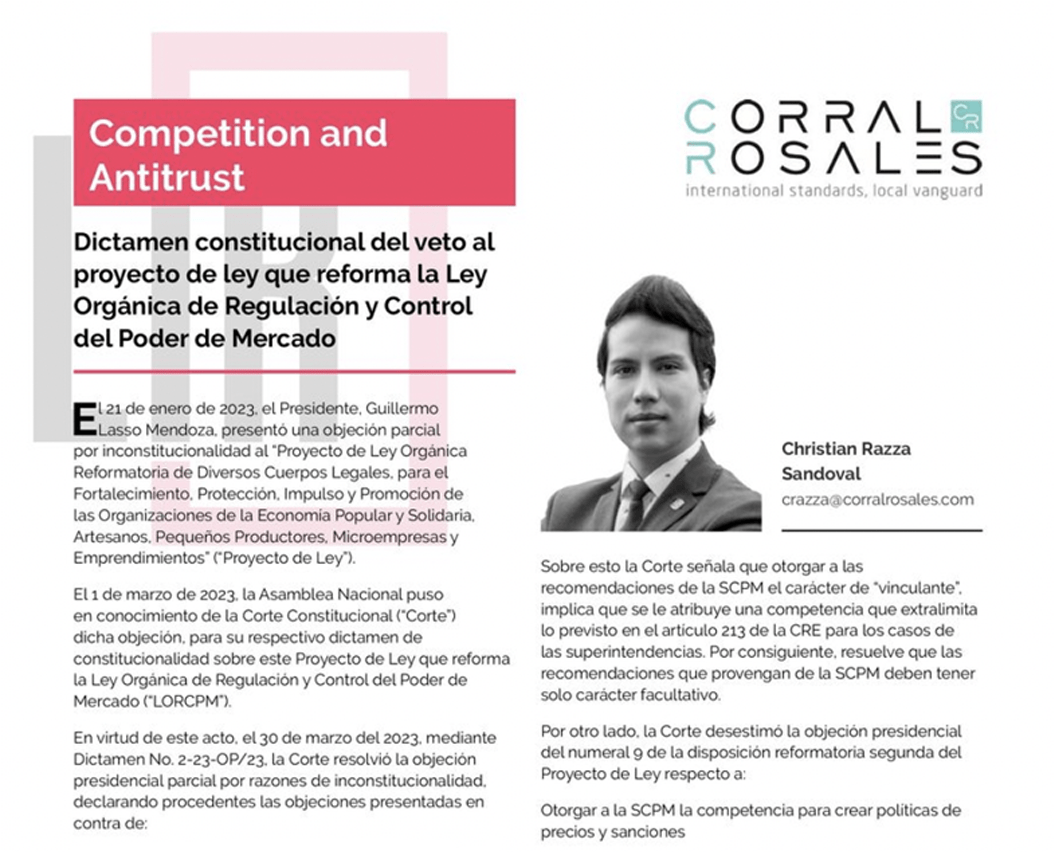
Constitutional opinion of the veto to the bill that reforms the Organic Law of Regulation and Control of Market Power

Recorte de "The Legal Industry Reviews", el artículo escrito por Christian Razza

DETAILS

DATE: 10-05-2023

PROFESSIONALS INVOLVED IN THE ARTICLE:

Christian Razza

On January 21, 2023, President Guillermo Lasso Mendoza filed a partial objection for unconstitutionality to the “Draft Organic Reformatory Law of Various Legal Bodies, for the Strengthening, Protection, Impulse and Promotion of Popular and Solidarity Economy Organizations. Artisans, Small Producers, Micro-enterprises and Enterprises” (“Bill”). Our associate Christian Razza writes about it for The Legal Industry Reviews (LIR).

Razza recalls that on March 1, 2023, the National Assembly informed the Constitutional Court (“Court”) of the presidential objection, so that it may issue the respective opinion on the constitutionality of this norm that reforms the Organic Law of Regulation and Control of Market Power (“LORCPM”).

In this regard, it adds that on March 30, 2023, by means of Opinion No. 2-23-OP/23, the Court resolved the partial presidential objection on grounds of unconstitutionality, declaring the objections filed against:

1. Conferring to the Superintendency for the Control of Market Power (“SCPM”) the competence to regulate the modification or elimination of public aid and pricing policies.

In this regard, Razza emphasizes that “the Court pointed out that these provisions contravene Articles 132 paragraph 1, 147 paragraph 3 and 213 of the Constitution of the Republic of Ecuador (“CRE”) since the creation, definition, elimination and modification of any type of pricing policies and public aid are not within its competence”. 

2.Granting the SCPM the power to issue recommendations on the modalities of competition in the markets of a binding nature only for public entities.

Razza points out that “paragraph 17 of the second reforming provision of the Bill allows the SCPM to review in a binding manner the pricing policy implemented by the Executive Branch”.

Therefore, the Court points out that “the Court states that granting the SCPM’s recommendations the ‘binding’ character implies that it is attributed a competence that exceeds the provisions of Article 213 of the CRE for the cases of the superintendencies. Consequently, it resolves that the recommendations coming from the SCPM must have only an optional character”.

If you want to read the complete article, click here.

Dissolution of Congress

In application of the powers conferred by Article 148 of the Constitution, the President of the Republic issued Decree No. 741 (the “Decree”) whereby the President dissolves Congress and ordered the National Electoral Council to call for legislative and presidential elections to complete the current respective terms.

The aforementioned powers allow the President to dissolve Congress when, in his opinion, there is a “serious political crisis and internal commotion”. It does not require the prior determination of the Constitutional Court and may be exercised only once during the first three years of office.

The National Electoral Council, within a maximum term of 7 days after the publication of the Decree, will call for legislative and presidential elections for the remainder of the current term, which ends in May 2025.

To sum up,  i) the President has made use of a constitutional power expressly contemplated in Article 148 of the Constitution; and, ii) in approximately 6 months a new President and Vice President of the Republic and members of Congress will take office, for a term to end in May 2025. In the meantime, the President remains in office and may issue economic decree laws, with the approval of the Constitutional Court.

Xavier-Rosales-abogados-ecuador

Leader of the Competition, Corporate and M&A areas
Xavier Rosales, partner at CorralRosales
xrosales@corralrosales.com
+593 2 2544144

Would you like to receive our newsletters with information like the one you have just read?
Click here and subscribe.

NOTE: The above text has been prepared for informational purposes. CorralRosales is not liable for any loss or damage incurred as a result of acting or failing to act on the basis of the information contained in this document. Any additional determined situation requires the specific opinion and concept of the firm in Quito / Guayaquil, Ecuador.

CORRALROSALES

Ecuador China Free Trade Agreement

On May 10 and 11, 2023 – due to the time difference – Ecuador and China signed a Free Trade Agreement focused on the commercial exchange of goods and e-commerce.

During 2022 Ecuador exported to China around US$5,823 million in products such as shrimp, lead and copper concentrate, other mining products, bananas, balsa, wood, cocoa, among others. China exported to Ecuador approximately US$6,353 million in products including metal products, vehicles, automobiles, cell phones, computers, among others.

Once the treaty enters into force, Ecuador’s products will have access to a market of 1.4 billion consumers and will be subject – for the most part – to immediate tariff relief. Ecuador’s tariff relief for Chinese products is subject to percentages and deadlines depending on the goods. With this, Ecuador will compete with countries such as Peru and Central America that already have a treaty with the Asian country.

The treaty will become effective once it complies with the respective legal process, which includes the pronouncement of the Constitutional Court, approval by the National Assembly, and publication in the Official Gazette.

In the following link you can review the complete text in Spanish:
https://www.produccion.gob.ec/wp-content/uploads/2023/05/FTA-ECUADOR-CHINA-SPANISH.pdf

New definition of strategic medicines

Boletín general de CorralRosales - Foto edificio con cristalera

The Regulation STFP-009-725-2023 of March 15, 2023 (the “Regulation”), issued by the Board for Fixing and Reviewing the Prices of Medicines for Human Use and Consumption (the “Board”) approved the new definition of strategic medicines, effective as of March 30, 2023.   

According to the Regulation, strategic medicines will be those subject to any of the following criteria:

a.    Medicines included in the National List of Basic Medicines (“CNMB”), except those included in the “List of OTC Medicines” published by the National Agency of Regulation, Control and Sanitary Surveillance (“ARCSA”)
b.    CNMB medicines, except those in which the number of competitors allows the release of its price.  
c.    Medicines that the Ministry of Public Health considers necessary for managing health strategies, programs, plans, and projects, including treating chronic, rare, catastrophic, and orphan diseases.
d.    Medicines not appearing in the CNMB and whose acquisition has been authorized under Ministerial Agreement No. 18 published in the Official Gazette Supplement 573 of November 9, 2021 (or the norm that replaces it). 
e.    Medicines that the Superintendence of Control of Market Power qualifies as monopolistic or have relevant restrictions to competition.  
f.    Medicines containing active ingredients that have not been marketed in Ecuador. 

Additionally, the Regulation establishes that:

i.    As of March 30, 2023, medicines included in ARCSA’s “List of OTC Medicines” will belong to the price-released regime. 
ii.    Until April 21, 2023, holders of valid sanitary registrations shall report to the Technical Secretariat of the Council (the “Secretariat”) the units sold and the retail price marked on the packaging to determine the medicines that will be under the constant criterion in paragraph b.
iii.    Until June 30, 2023, the Secretariat must generate the methodology to determine the medicines to be covered by the criteria in paragraph b and send it to the Council for approval. After approval, the Secretariat will have one month to submit to the Council the technical reports for issuing the list of medicines that will meet the indicated criterion.
iv.    Until June 30, 2023, the Secretariat must submit to the Council the technical reports for issuing the list of medicines that will be subject to the price-regulated regime based on this new definition.
 

Mario Fernández - Boletín CorralRosales - Derecho Corporativo - Contratación Pública - Sector Eléctrico - Ecuador

Specialist in Corporate and Public Contracting Law
Mario Fernández, associate at CorralRosales
mfernandez@corralrosales.com
+593 2 2544144

Would you like to receive our newsletters with information like the one you have just read?
Click here and subscribe.

NOTE: The above text has been prepared for informational purposes. CorralRosales is not liable for any loss or damage incurred as a result of acting or failing to act on the basis of the information contained in this document. Any additional determined situation requires the specific opinion and concept of the firm in Quito / Guayaquil, Ecuador.

CORRALROSALES