
Non-Intrusive inspection for customs matters

Non-intrusive inspection for customs matters - CorralRosales - Tax Bulletin - Abogados Ecuador

The President issued the Executive Decree 227 on October 19, 2021, by which the customs regulations were amended to allow non-intrusive inspections. Below a summary of the mos important matters:

1.    Definitions:

The following 3 definitions were added:

•    Non-intrusive equipment: Equipment, machines or devices that have a source of X-ray emission, which allow through tunnels and arches to obtain images from different angles, which have an interface or computer system with a series of tools that allow the discrimination of densities by color, size increase, mobilization, management of brightness, contrast, measurement, among other tools.

•    Physical inspection: Action carried out by the competent authorities, which may be performed simultaneously, in order to verify the nature, origin, condition, quantity, value, tariff classification and regulatory treatment of the goods.

•    Non-intrusive inspection: Action carried out by the competent authorities, which may be performed simultaneously, in order to verify the nature of the goods, through the use of non-intrusive equipment that allows scanning the merchandise inside a container, cargo unit, packaging, package or any other object, without having to unload it, in order to compare with the information in the customs declaration and verify compliance with the applicable regulations.

2.    Non-intrusive physical inspection

The non-intrusive physical inspection was included. Through this type of inspection, the nature and other characteristics of the goods will be verified by means of the exclusive use of non-intrusive equipment and applying risk profiles established by the Customs Authority.

3.    Control with non-intrusive equipment

In the case of imports, the Customs Authority will establish which customs warehouses must have the necessary equipment for non-intrusive inspections to be made to goods, cargo units and means of transport that have been risk profiled.

In the case of exports, all goods, cargo units and means of transport will be subject to controls with non-intrusive equipment by the Customs Authority.

The Customs Authority will have a term of 60 days to establish the minimum requirements to be met by the non-intrusive equipment. Once these requirements are established, the Customs Authority must establish which warehouses, ports, airports, and border crossings require the implementation of such equipment, which must operate within 12 months from the publication of the decree in the Official Gazette.

4.    Concurrent control

The Customs Authority may request documents different from the supporting and accompanying customs documents in order to establish the accuracy and veracity of the data included in the customs declarations.

Andrea Moya - CorralRosales - Lawyer Ecuador

Specialist in Tax matter

Andrea Moya, associate at CorralRosales
amoya@corralrosales.com
+593 2 2544144

Do you want to receive our newsletters with information like the one you just read?
Click here and subscribe.


DISCLAIMER: The previous text has been prepared for informational purposes. CorralRosales is not responsible for any loss or damage caused as a result of having acted or stopped acting based on the information contained in this document. Any additional determined situation requires the specific opinion and concept of the firm.

CORRALROSALES

New regulations for employment termination with cause procedures known as “visto bueno”

New regulations for employment termination with cause procedures known as "visto bueno" - CorralRosales - Lawyers Ecuador - Latam

On August 13th, 2021, the Ministry of Employment, through Ministerial Agreement MDT-2021-219, issued new regulations governing the procedure to be followed for the approval of Employment Termination with Cause (known as and hereinafter, “Visto Bueno”). The new process will be effective as of September 24, 2021.

The main features of the new procedure are as follows:

1.    Jurisdiction: The competent employment inspector to handle requests for Visto Bueno is that of the territorial circumscriptions of the place where the employment agreement was executed or that of the place of the employees’ domicile.

2.    Appearance: The parties may appear in person or by proxy, accompanied by a defense attorney, who may act by legal proxy or by simple written authorization.

3.    Notifications:  The Visto Bueno request must be notified to the employee by ballot delivered to his/her workplace or domicile. The latter may be received by an employee’s relative or be posted on the door of the domicile in case there is no one to receive it, or if the employee refuses to do so.

If it is impossible to locate the employee, he/she may be notified by e-mail, provided that there is a document whereby the employee states its clear and express acceptance to be notified by such mean.

Notification by the press: If it is not possible to notify the employee by any of the means described above, it may be done through a single publication in one of the newspapers with the largest circulation in the place where the Visto Bueno process is carried out. For this purpose, the employer must carry out a statement before a Public Notary that he/she does not know the employee’s domicile. After 20 days since the publication, the employment inspector shall set a date and time for an investigation hearing.

4.    Suspension of the employment relationship: Before or after  filing  the Visto Bueno the employer may request the suspension of the employment relationship. To this end, a certified copy of the employee’s payroll corresponding to the last full monthly remuneration must be attached and the relevant amount must be deposited in the account designated by the Ministry of Employment to this effect.

5.    Response to the Visto Bueno request: The employee shall answer to the Visto Bueno request within 2 working days of being notified with the procedure. Failure to do so will result in the inspector continuing with the proceedings in absentia.

6.    Investigation hearing: Once the term to submit the response to the Visto Bueno´s request has lapsed, the inspector shall, within the following 3 working days, set a date and time for the investigation hearing.

The investigation hearing may be held at the inspector’s office or, if necessary, at the place where the facts leading to the Visto Bueno occurred.

The inspector may, exceptionally, and for the purpose of clarifying the facts of the dispute, suspend the investigation for up to 3 days. The inspector may not formally require public or private entities in order to obtain evidence.

Once the investigation hearing has concluded, the inspector will have 3 working days to issue a resolution.

Specialist in Labor Law

Marta Villagómez, associate at CorralRosales
mvillagomez@corralrosales.com
+593 2 2544144

Do you want to receive our newsletters with information like the one you just read?
Click here and subscribe.

DISCLAIMER: The previous text has been prepared for informational purposes. CorralRosales is not responsible for any loss or damage caused as a result of having acted or stopped acting based on the information contained in this document. Any additional determined situation requires the specific opinion and concept of the firm.

CORRALROSALES

Outflow tax (ISD) applicable to foreign airlines

Outflow tax (ISD) applicable to foreign airlines - CorralRosales - Abogados Ecuador - Latam

Executive Decree 182 issued by the President on September 2, 2021, establishes that transfers of money abroad made by foreign airlines authorized to operate in Ecuador will be subject to 0% rate of Outflow Tax (ISD).

In order to apply the 0% rate, airlines must be designated by the authority of their country to develop in Ecuador activities of international transportation of passengers, cargo, a combination of them or cargo only.

This Decree will enter into force from the date it is published in the Official Gazette. The Internal Revenue Service shall issue the necessary regulations to implement the Decree within 15 workings days from its publication.

Especialista en Tributario y Aduanero
Andrea Moya, socia de CorralRosales
amoya@corralrosales.com
+593 2 2544144

Do you want to receive our newsletters with information like the one you just read?
Click here and subscribe.

DISCLAIMER: The previous text has been prepared for informational purposes. CorralRosales is not responsible for any loss or damage caused as a result of having acted or stopped acting based on the information contained in this document. Any additional determined situation requires the specific opinion and concept of the firm.

CORRALROSALES

Ecuador´s action plan for the mining sector

Ecuador´s action plan for the mining sector - CorralRosales - Lawyers Ecuador
Through Executive Decree 151, signed on August 5, 2021, the President of Ecuador issued an Action Plan for Ecuador’s Mining Sector (from now on “Action Plan”) that seeks promoting development through the positioning of mining as a relevant industry of the country’s economy.

The main objective of this Action Plan is to articulate the development of efficient and responsible mining and promoting national and foreign investment to achieve the exploitation of Ecuadorian mineral resources through the best practices in the industry.

In turn, through this Action Plan, Ecuador also seeks to reaffirm its commitment to guarantee legal security by complying with existing regulations and respecting pre-existing rights.

With this in mind it is important to highlight the guidelines, included in the Action Plan, that the Ministry of Energy and Natural Resources (after this “the Ministry”) must follow. On this sense, the Ministry must:

1. Communicate clear and transparent information regarding the amount and destination of benefits and taxes received from the mining industry, and regarding public policy in this matter.

2. Design a comprehensive plan for the prevention, combat, and application of sanctions to the illicit exploitation of minerals.
3. Work with the Ministry of the Environment, Water and Ecological Transition so that the appropriate measures are adopted for environmental permits related to the mining industry to be resolved in a timely manner, so they do not interfere with investment commitments.

4. Instruct the National Mining Company ENAMI EP to facilitate associative agreements to attract and allow the participation of private investors.

5. Promote the adoption and compliance with international codes, protocols, agreements, declarations and instruments in each of the phases of the mining activity.

6. Encourage the adoption of socially and environmentally responsible practices and respect for labor rights and access to complaint mechanisms.

7. Develop a technological tool that facilitates and guarantees the correct exercise of current and future mining rights.

The Action Plan also instructs the Agency for the Regulation and Control of Energy and Non-Renewable Natural Resources to prepare a detailed report about mining rights conceded under the regimes of large mining, medium mining, small mining and artisanal mining that have been granted and are in force.

Finally, the Action Plan provides that the Ministry presents a project to create a Public-Private Mining Advisory Council that will promote civil society participation in the construction of public mining governance.

Do you want to receive our newsletters with information like the one you just read?
Click here and subscribe.

DISCLAIMER: The previous text has been prepared for informational purposes. CorralRosales is not responsible for any loss or damage caused as a result of having acted or stopped acting based on the information contained in this document. Any additional determined situation requires the specific opinion and concept of the firm.

CORRALROSALES

Regulations for the return to in person work activities in the private sector

Regulations for the return to in person work activities in the private sector - CorralRosales - Lawyers in Ecuador

The Ministry of Labor issued Ministerial Agreement MDT-2021-214, published in the Official Register No. 507 of August 02, 2021, that contains the “Guidelines to Return to In Person Work Activities”. Hereafter their main features:

With the exceptions detailed below, it is up to employers to determine if employees return to in person work, whether they are immunized or not.

Employers must comply with the “Guide and General Plan for the Progressive and Safe Return to In Person Work Activities” approved on June 29, 2021, by the Emergency Operations Committee – COE National.

Employees with aggravating conditions or who have under their care a person with an aggravating condition, who have been vaccinated and necessary time for immunization has lapsed, shall return to in person work.

Even if employees with aggravating conditions are immunized -or the individual with aggravating conditions under their care is immunized- if the occupational physician or a center accredited by the Ministry of Public Health, certifies that the employees may not perform in person work, he or she will remain under telework modality.

Employer´s failure to comply with the Ministerial Agreement may be sanctioned by the Ministry of Labor with a fine up to one (1) minimum statutory wage (currently US$400).

Aggravating conditions are considered:

  • Individuals over 65 years old.
  • Individuals with chronic non-transmissible diseases.
  • Individuals with cardio-vascular diseases.
  • Individuals with cerebrovascular diseases.
  • Individuals whit disability of 50% or more.
  • Pregnant and breastfeeding women.
  • All types of congenital malformations of the heart and all types of heart valve diseases.
  • Oncological and oncohematological patients with recent diagnosis or active disease.
  • Individuals with brain tumor in any state and any type.
  • Chronic renal insufficiency.
  • Cirrhosis.
  • Individuals who have received an organ transplant or are waiting for a transplant.
  • Individuals with sequels of severe burns.
  • Individuals with Klippel Trenaunay syndrome.
  • Individuals with thoracic-abdominal aneurysm.
  • Individuals with HIV.

Do you want to receive our newsletters with information like the one you just read?
Click here and subscribe.

DISCLAIMER: The previous text has been prepared for informational purposes. CorralRosales is not responsible for any loss or damage caused as a result of having acted or stopped acting based on the information contained in this document. Any additional determined situation requires the specific opinion and concept of the firm.

CORRALROSALES

Implementation of boards of directors of the port authorities of Guayaquil, Manta, Puerto Bolívar and Esmeraldas

Implementation of boards of directors of the port authorities of Guayaquil, Manta, Puerto Bolívar and Esmeraldas - CorralRosales - Lawyers Ecuador
By Executive Decree 78 of June 15, 2021, the President of the Republic implemented the boards of directors of the Port Authorities of Guayaquil, Manta, Puerto Bolivar and Esmeraldas.

The boards will be constituted as follows:

1. Members of the board of directors:

  1. A member appointed by the President of the Republic, who shall preside over the board of directors
  2. A member appointed by the General Commander of the Navy of Ecuador, who will replace the president of the board of directors in case of absence.
  3. A member appointed by the Ministry of Production, Foreign Trade, Investment and Fisheries.
  4. A member appointed by the Ministry of Transportation and Public Works; and
  5. A member appointed by the Customs Administration.

The Subsecretary of Ports and Maritime and River Transportation of the Ministry of Transportation and Public Works will act as secretary of the boards of directors. The members of the board of directors are freely appointed and removable officials.

The President of the Republic is responsible for appointing the managers of the Port Authorities of Guayaquil, Manta, Puerto Bolivar and Esmeraldas.

2. Functions of the board of directors (Article 8 of the National Port Administrative Regime Law):

  1. Submit an annual report to the Direction of the Merchant Marine and Littoral -currently Subsecretary of Ports and Maritime and Fluvial Transportation of the Ministry of Transportation and Public Works- on the activities carried out during the previous fiscal year.
  2. To appoint the Departmental Chiefs from among the candidates suggested by the Manager.
  3. To know and approve the Financial Statements, balance sheets, and other reports of the Entity.
  4. Approve the Port Services Regulations, organization manuals, personnel organization manuals and other pertinent regulations, based on the preliminary drafts submitted by the Manager; and formulate the regulations of uniform application to all the Port Entities, to be submitted for consideration of the Direction of the Merchant Marine and Littoral -currently the Subsecretary of Ports and Maritime and Fluvial Transportation of the Ministry of Transportation and Public Works.
  5. To authorize the Manager to sign contracts, investments, acquisitions, studies and other acts necessary for the fulfillment of the purposes of the Entity, the amount of which requires the Bidding Contest, subject to the Bidding Law -current public contracting regulations- and the approved Budget.
  6. To resolve in second instance the claims of the users, in all matters related to port services.
  7. The others determined in the General Ports Law and in the respective statutes.

3. Liability of the members of the board of directors (Article 11 of the National Port Administrative Regime Law):

They are civilly and criminally responsible, personally and jointly and severally, for all acts or resolutions that are detrimental to the interests of the Entity and that have been taken with their vote. They are especially liable for decisions that contravene Port policy and resolutions issued by higher authorities. The manager and officers of the Entity shall also be liable for their participation in such acts.

Do you want to receive our newsletters with information like the one you just read?
Click here and subscribe.

DISCLAIMER: The previous text has been prepared for informational purposes. CorralRosales is not responsible for any loss or damage caused as a result of having acted or stopped acting based on the information contained in this document. Any additional determined situation requires the specific opinion and concept of the firm.

CORRALROSALES

New methodology for the calculation of fines for infractions to the Organic Law for the Regulation and Control of Market Power

New methodology for the calculation of fines for infractions to the Organic Law for the Regulation and Control of Market Power - CorralRosales - Lawyers Ecuador
The Resolution No. SCPM-DS-2021-19 issued by the Superintendency of Market Power Control (“SCPM”) containing the new methodology for the calculation of fines for committing infractions to the Organic Law for the Regulation and Control of Market Power (the “LORCPM” and the “Fines Calculation Resolution”, as appropriate) was published in the Fourth Supplement to the Official Gazette No. 465, on June 3, 2021.

Along with other modifications introduced in the Regulation for the Application of the Organic Law for the Regulation and Control of Market Power (“RALORCPM”) last December, the power to determine fines was brought back to the SCPM. Up until this reform, the determination of fines was regulated by Resolution No. 012, issued by the Market Power Regulation and Control Board (“Resolution 012”).

Although this new calculation model is based on the same principles as Resolution 012, it provides greater clarity in the application and, therefore, greater predictability – and the possibility of verification – of the fines that may be imposed in the event of an infringement of the LORCPM. The calculation formulas incorporated in the Fines Calculation Resolution continue to have a certain level of complexity, but each term is clearly defined, which will allow the fined operator to verify it.

The Fines Calculation Resolution seeks to transmit a dissuasive effect on economic operators through the application of exponential fines, so that those imposed for the most serious anti-competitive acts are proportional and markedly higher to those applicable to the less serious infractions.

The aforementioned resolution establishes the following criteria for the calculation:

  1. Turnover in the relevant market
  2. Degree of participation in the relevant market
  3. Temporality
  4. Size of the relevant market
  5. Market concentration and state of competition
  6. Geographical determination segmented by province or at the national level.
  7. Effect of the infringement on the rights and legitimate interests of consumers and users or on other operators
  8. Benefits obtained as a result of the infringement.
  9. Proportion
  10. Weighing
  11. Damage to the competition
  12. Subsidiarity
  13. Aggravating and mitigating circumstances that concur in relation to each of the investigated/responsible parties.

And establishes as calibration parameters the severity rating as set forth by the LORPCM (mild, serious, or very serious) as well as specific rules for agreements and restrictive practices by object and for collusion (in bids, auctions, contests, and the like).

Among the novel parameters of the methodology, we highlight the inclusion of a differentiated weighting criterion for each of the provinces affected by the illegal conduct.

Additionally, the Fines Calculation Resolution introduces the regulation of fines applicable to the following circumstances/behaviors, which are determined in article 79 of the LORCPM:

  • Sanctions to legal representatives or members of the governing bodies of the infringing economic operator.
  • Cases of noncompliance with information requests by the Authority, delivery of incomplete information and delivery of incorrect information.
  • Calculation of coercive fines, depending on the delay – in days – to comply with the Authority´s decision.
  • Calculation of fines for obstruction of inspections.
  • Fines for failure to comply with a resolution.

The Fines Calculation Resolution is applicable in sanctioning procedures that begin after its publication in the Official Gazette (June 3, 2021). The determination of fines regarding sanctioning procedures that are in the investigation or sanction stage will be governed by the norm in force at the time of their initiation.

Do you want to receive our newsletters with information like the one you just read?
Click here and subscribe.

DISCLAIMER: The previous text has been prepared for informational purposes. CorralRosales is not responsible for any loss or damage caused as a result of having acted or stopped acting based on the information contained in this document. Any additional determined situation requires the specific opinion and concept of the firm.

CORRALROSALES

Amendments to regulations for traceability of medicines and medical devices

Amendments to regulations for traceability of medicines and medical devices - CorralRosales - Lawyers Ecuador
Regulation ARCSA-DE-010-2021-LDSS issued on May 19, 2021, amended Regulation ARCSA-DE-030-2020-MAFG, published in the Official Gazette of November 26, 2020, through which the “Substitute Technical Sanitary Regulation establishes the guidelines for the Control of Traceability of Medicines, Biological Products and Medical Devices” was issued. The main aspects of this reform, which entered into force on the date of its subscription, are the following:

1.It is clarified that the inclusion of the unique traceability code in the packaging of medicines, biological products, and medical devices does not require a modification to their marketing authorization unless changes must be made to the packaging to include said code.

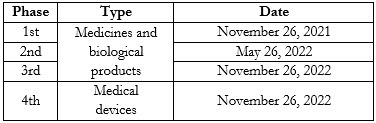
2. The maximum term to implement the traceability of medicines, biological products, and medical devices (hereinafter, the “Products”) is modified, depending on the phase to which they correspond. The national health authority shall determine the Products list for each phase.

3. The members of the National Traceability System (hereinafter, “SNT”) must submit to the National Agency for Sanitary Regulation, Control and Surveillance (hereinafter, “ARCSA”) a gradual plan for the implementation of the traceability of their Products (hereinafter, “Gradual Plan”), according to the regulations issued[1] by ARCSA for this purpose.

4. Until ARCSA has a computer system to control the traceability of the Products, the members of the SNT must record the logistical movements of their Products in the system they have for that purpose.

5. The ARCSA computer system will have a database where all the records generated by the systems of each SNT member will be stored. The characteristics of the ARCSA system shall be indicated in the regulations issued by the said authority for this purpose.

Do you want to receive our newsletters with information like the one you just read?
Click here and subscribe.

DISCLAIMER: The previous text has been prepared for informational purposes. CorralRosales is not responsible for any loss or damage caused as a result of having acted or stopped acting based on the information contained in this document. Any additional determined situation requires the specific opinion and concept of the firm.

CORRALROSALES

Income and VAT withholdings regime applicable to payment aggregators and online markets

Income and VAT withholdings regime applicable to payment aggregators and online markets - CorralRosales - Lawyers Ecuador
Regulation NAC-DGERCGC21-00000026 issued by the Tax Authority and published in the Third Supplement to Official Gazette 461 of May 28, 2021, establishes special rules for income tax and value added tax (VAT) withholdings.

Do you want to receive our newsletters with information like the one you just read?
Click here and subscribe.
DISCLAIMER: The previous text has been prepared for informational purposes. CorralRosales is not responsible for any loss or damage caused as a result of having acted or stopped acting based on the information contained in this document. Any additional determined situation requires the specific opinion and concept of the firm.

CORRALROSALES

Effects of the derogation of the Regulations for the Application of the Organic Law of Communication in advertisement production

Effects of the derogation of the Regulations for the Application of the Organic Law of Communication in advertisement production - Lawyers Ecuador - CorralRosales
The President, Guillermo Lasso Mendoza, issued the Executive Decree No. 32 on May 24th, 2021, which ordered the derogation of the Regulations for the Application of the Organic Law of Communication.

The Organic Law of Communication (“LOC”) determines, in article 98, the rules of nationality for the production of advertisement to be disseminated through social communication media (“Rules of Nationality of Production”) which establish that advertisements transmitted through the social communication media:

Art. 98. – Production of National Advertising. – Advertising that is disseminated in Ecuadorian territory through the communication media must be produced in Ecuadorian territory by Ecuadorian natural persons or foreigners residing in Ecuador or produced abroad by Ecuadorian persons residing abroad or foreign legal entities whose ownership of the majority of the shares in said entity is held by Ecuadorian persons and whose payroll for its realization and production is made up of at least 80% of people of Ecuadorian nationality.

This payroll percentage will include the hiring of professional services.

The import of advertising pieces produced outside the country by foreign companies is prohibited, with the exception set forth in the first paragraph regarding foreign legal entities with a majority of the share package held by Ecuadorian persons.

For the purposes of this law, advertising production is understood to be television and film commercials, radio sports, photographs for static advertising, or any other audiovisual piece used for advertising purposes.

The advertising of international campaigns designed to promote respect and the exercise of human rights, peace, solidarity and human development is exempt from what is established in this article.

Social communication media are defined in the LOC as: “… public and private entities and community organizations, as well as the concessionaires of radio and television frequencies, who provide the public service of mass communication that utilize print media o radio services, television and audio and video subscription services, whose contents can be generated or replicated by the media through the internet.”

The Regulation for the Application of the LOC, among other aspects, regulated the application of the Rules of Nationality of Production for advertisement through alternative channels other than social communication media; and clarified on its application for each type of advertising piece in the case of advertisements aimed at promoting tourist destinations or events abroad or those in which the images of famous people or animated fictional characters that are the image of the brands are used. The derogatory provided by Executive Decree 32 has the following relevant implications in terms of advertising:

– Advertisement to be disseminated through alternative media such as (i) billboards or photographs located in public space in commercial premises; (ii) catalogs; (iii) flyers is no longer subject to the Rules of Nationality of Production.

– Importing printed advertising materials such as diaries, notebooks and catalogs is allowed.

– There is no prohibition for advertisement photography to be disseminated by social communication media to be taken by a foreign photographer – that is not an Ecuadorian resident – as long as the Rules of Nationality of Production regarding the property of the producer is complied with and the production team is at least made up of 80% Ecuadorians.

– There are no guidelines that regulate the application of Rules of Nationality of Production in the case of advertising intended to promote touristic destinations or events located outside Ecuador, the use of images of famous people or animated characters that are the international image of a brand (the derogated Regulations for the application of the LOC allowed the use of these videos/images for up to 20% of the duration of the video or the composition of the piece).

Do you want to receive our newsletters with information like the one you just read?
Click here and subscribe.

DISCLAIMER: The previous text has been prepared for informational purposes. CorralRosales is not responsible for any loss or damage caused as a result of having acted or stopped acting based on the information contained in this document. Any additional determined situation requires the specific opinion and concept of the firm.

CORRALROSALES